Horses
Women TalkingHorses in the Molotschna Colony are both indispensable working animals and a recurring measure of how people respond to danger. Ruth and Cheryl, Greta Loewen’s team, figure in the women’s argument about leaving: their instinct to run when frightened becomes an image for avoiding harm, while their dependence on reins complicates the comparison between animal judgment and human direction. As the women prepare to depart, the horses are not merely a metaphor. Their teams are part of the practical means by which the group intends to travel.
Work and daily life
The horses belong to a world organized around animal care and labor. The women’s gathering takes place in a loft where ordinary objects are repurposed: hay bales support plywood as a table, milking buckets serve as chairs, and saddles taken from Earnest Thiessen’s tack room are set on a beam for Autje and Neitje to sit on. The saddles make the animals’ work tangible even while the horses themselves are not present in the meeting. Their equipment has been brought into a space where the women are weighing decisions about safety and their future.
Animal care also marks the daily obligations that continue around the gathering. As the day ends, the cows need milking and Dueck’s dogs bark for their dinner, though Dueck is away in the city and, in the account, is the only person who would care to feed them. Agata argues that the women remaining on the ground can manage milking and supper preparations while the others stay in the loft to settle their concerns. Against this backdrop of work, the proposed departure entails more than a change of place: it requires carrying the means of survival and reorganizing the labor that sustains people and animals.
Ruth and Cheryl in Greta’s account
Greta Loewen, the eldest of the Loewen women, though born a Penner, speaks of Ruth and Cheryl with melancholic dignity. Ruth is blind in one eye and must always be harnessed to Cheryl’s left. When one or more of Dueck’s Rottweilers frighten the pair on the mile road leading to church, their first impulse is to bolt. Greta emphasizes that the horses do not hold meetings to decide what to do. They run, and by running they evade the dogs and the possible harm.
The story gives the horses a simple but consequential place in the debate. Greta uses their response to danger to challenge the idea that deliberation is always safer than action. For the women, who have little time to decide what to do after the imprisoned attackers may return, Ruth and Cheryl’s flight offers an example of escape rather than prolonged exposure to threat. The comparison does not make the women’s circumstances identical to the horses’: it gives the argument a concrete image drawn from Greta’s daily experience with her team.
Greta also describes learning to look far down the narrow road between Molotschna and Chortiza rather than fixing her gaze immediately in front of the team. The road has deep gullies on either side. Before she changed how she looked ahead, her buggy weaved and lurched; she recognizes that Ruth and Cheryl were following her commands, but that her commands had been jerky and dangerous. In her account, the horses’ movement is tied to the person holding the reins: their safety depends in part on the driver’s attention and direction.
Reins, judgment, and the argument about leaving
Greta extends the road image to the women’s decision. Leaving, she argues, could give them the longer view needed to forgive properly and keep peace according to their faith. She presents departure not as cowardice, abandonment, disobedience, rebellion, exile, or expulsion, but as an act consistent with faith. The horses’ need to follow a driver’s commands thus helps her explain why distance might enable a different perspective: remaining close to immediate danger can make it harder to see a safe course forward.
Mejal tactfully returns the discussion to Ruth and Cheryl and presses on the limits of the analogy. She asks whether the horses would have looked far down the road if human pressure on the reins had not directed their gaze, and whether they could have avoided the gullies without a human hand guiding them. Her questions make the team more than evidence for Greta’s position. The same example can be read as a demonstration of the horses’ response to danger or as a reminder that their conduct is shaped by human commands. The debate turns on the relationship between an animal’s movement and the person controlling the reins, just as the women are considering how much their own choices have been shaped by authority.
Teams, seizure, and departure
The horses’ material importance becomes explicit when Klaas Loewen turns to Greta and says he is taking her team. He has seen the team in the yard at Earnest Thiessen’s farm and describes the animals as appearing healthy, with clear eyes and shining coats. His claim to them makes the risk of departure immediate: the women are not discussing an abstract journey but trying to retain the animals and teams needed to make one. Earlier, Klaas had instructed younger women to find and tie up the yearlings because they were too young to be sick, bringing the care and control of horses into the conflict over who can act in the colony.
When the women settle the practical terms of leaving, Ona says they will need to take animals—pigs, cows, and chickens—for food along the way, as well as Ruth and Cheryl and the other women’s teams. The women echo the insistence that Ruth and Cheryl must come, facetiously, but the horses’ inclusion in the plan is practical as well as affectionate. Agata has secured food for the trip to be packed in her buggy. August reports that the safe is in the back of Greta’s buggy beneath the rear seat, alongside onions, soap, and pieces of wood for traction if the wheels become mired in mud or for kindling. These preparations place the buggies and teams at the center of the planned movement without specifying every detail of the journey.
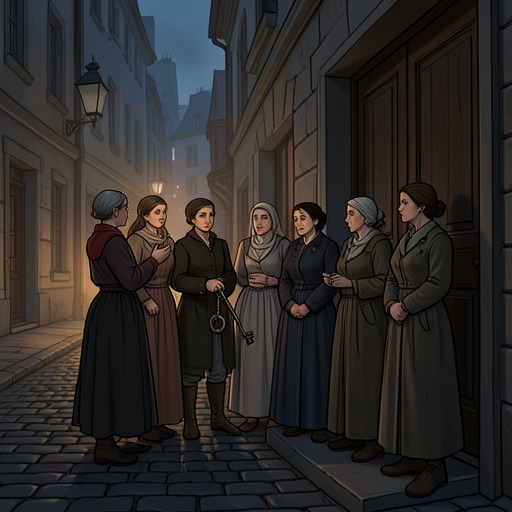
The departure is planned for after dark so the group will not be seen passing the Chortiza and Hiakjeke colonies. The women leave the loft and Molotschna, and August watches them go. The horses’ role has shifted from the subject of a meeting-room analogy to part of the material arrangement that makes leaving possible. Their presence connects the women’s deliberation to the road ahead: a team must be guided, a route must be anticipated, and the group must carry enough to continue once it has gone.